
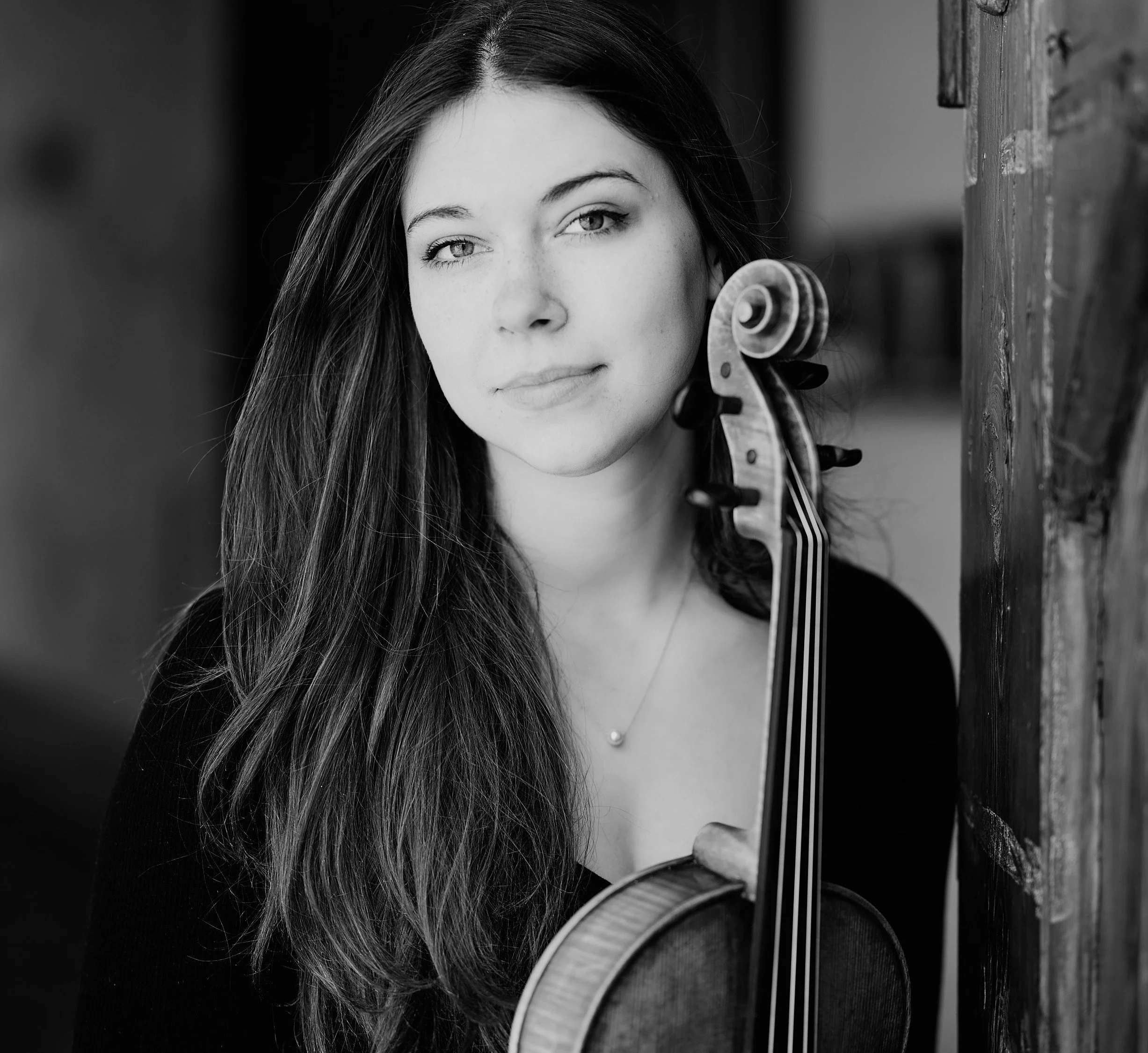
Born in Los Angeles in 1999, Emma Wernig is a German-Austrian violist who has quickly become recognized for her expressive artistry and distinctive musical voice, establishing herself as a rising star on the international stage.
A distinguished competition laureate, Emma was awarded the Barbirolli Prize at the 2019 Tertis International Viola Competition and won the Cecil Aronowitz International Viola Competition in 2017. These early successes were pivotal in launching her international career. In recognition of her exceptional talent, she also received the Wilo Foundation Prize in 2021, which continues to support her development as a soloist. These prestigious accolades paved the way for a vibrant performance career, which includes concertos, recitals, and chamber music performances across Europe and beyond.
Passionate about expanding the viola repertoire, Emma made her highly praised recording debut in 2021 with an album of rare Austrian viola works, recorded with pianist Albert Cano-Smit for the Champs Hill Records label. The album was met with critical acclaim for its innovative programming and rich interpretation. In 2024, she further expanded her discography with a recording (release TBA) of Alfred Schnittke's "Concerto for Three" alongside Gidon Kremer, Magdalena Ceple, and the Kremerata Baltica, underlining her ongoing commitment to both new and established repertoire.
As a soloist, Emma has performed with orchestras including the Kremerata Baltica, Meininger Hofkapelle, Württembergische Philharmonie Reutlingen, Folkwang Kammerorchester, and Französisches Kammerorchester, among others. Emma is also known for her creative approach to programming. An enthusiastic arranger, she often adapts works originally written for other instruments, such as cello, violin, and voice, for the viola, having debuted her own arrangement of Schumann’s Cello Concerto in the 2024/25 season.
In addition to her solo performances, Emma is the newly appointed violist of the award-winning, Doric String Quartet. Based in London, the quartet boasts a rich history and an acclaimed discography on the Chandos label, with a reputation for dynamic performances and cutting-edge programming. Upcoming projects include a full Beethoven cycle at Wigmore Hall, as well as international tours to America, Japan, Australia, and beyond. Emma is excited to contribute her unique voice to these ambitious projects, further strengthening the quartet’s renowned presence in the world of chamber music.
Emma has collaborated with many distinguished musicians, including Janine Jansen, Gidon Kremer, Lynn Harrell, Steven Isserlis, and Christian Tetzlaff and performed at prestigious festivals including the Verbier Festival, Aldeburgh Festival, Festspiele Mecklenburg-Vorpommern, Edinburgh Festival, Grachtenfestival, Grafenegg Festival, Krzyzowa Music, Gezeitenkonzerte, and the Vevey Spring Classic Festival.
In 2024, she served as 1st Principal Viola with the Danish Radio Symphony Orchestra and participated in the orchestra’s recording of Schönberg's "Verklärte Nacht" for Deutsche Grammophon under the baton of Fabio Luisi. She is also a regularly invited Guest Principal of the London Symphony Orchestra and BBC Symphony Orchestra.
Emma’s educational background includes a Bachelor's degree from the Colburn Conservatory of Music in Los Angeles, where she studied with Paul Coletti, and a Master’s degree from the Yale School of Music, where she studied with Ettore Causa and received the Lucy Grosvenor Memorial Prize. She has since completed an additional Master’s degree at the Hochschule für Musik Hanns Eisler in Berlin, studying with Tabea Zimmermann.
Emma plays a viola crafted by Jason Viseltear in 2019 and currently resides in London.
Emma Q&As
Daily life of a Musician -structure of the day
Truly different every day depending on travel or rehearsals but a day at home is broken up into practice, rest, feeding myself, and maybe seeing a friend.
* How do you cope with being on the road, or the time between?
Allowing for real rest when there is time for it and making sure I’m as present as I can be in all other settings.
* How do you cope with having all your focus and adrenaline at the end of the day when the rest of the world is winding down?
Not getting up too early :)
* What ignited the Chamber Music spark for you?
Playing with people at an early age that I became close friends with who were much better than me! It definitely sparked a desire to practice but also to want to keep being surrounded by playing and people that would inspire me to grow.
* What music in 2026 do you identify with most closely. Can you explain why?
I honestly spend as much of my time in silence as I can. So much of my day is already spent with music that hearing the world around me is a welcome change! Otherwise I love jazz standards, mo town, and have been loving recently released music by Olivia Dean and Raye as well!
* What do you consider a good balance of Contemporary music and music of an earlier era in programmes, or in your workload load.
We are in an art of preservation as well as innovation and I think in order to play contemporary music well, we need to really understand everything that came before it. I enjoy a healthy mix!
* How do you approach bringing a contemporary work to life?
Like with any other music: starting with what is on the page. So often we try to superimpose things onto contemporary music to compensate for something, but more often than not, the composer has provided everything we need.
* Venues: intimate venues versus huge concert hall
intimate venues!
* inspirational teachers, people or recordings /what got you into music?
All three of my major teachers: Paul Coletti, Ettore Causa, and Tabea Zimmermann have all been huge inspirations. However, most of all I think the incredible colleagues and friends that I have made music with and continue to play with end up in some ways inspiring me the most!
* What do you keep in your gig bag?
Whatever I can remember to throw in there!
* Pre-concert routines / post concert routine?
I like every concert to just feel like an extension of a rehearsal so it feels more like a part of the process rather than a result. It helps me not feel nervous and also to stay as present as I can onstage. This means for me making the concert feel like as little of a big deal as possible (while taking the time I need to warm up and get ready etc.). After the concert I’m a big fan of essentially going straight to bed… no fun at all!!!
* Drive/motivation/what keeps you wanting to play music?
Wanting to improve, grow, learn! It’s not always easy to stay motivated, but nothing works better than experiencing something inspiring in a rehearsal or concert or hearing someone else play to make you excited to try to get better!
* Favourite concert? (Seen/played)
My favorite concert to play is any one where I’m lucky enough to feel free and enjoy what I’m doing and who I’m doing it with! My favorite concert to listen to is any concert that feels honest and holds on to me for the entire duration.