
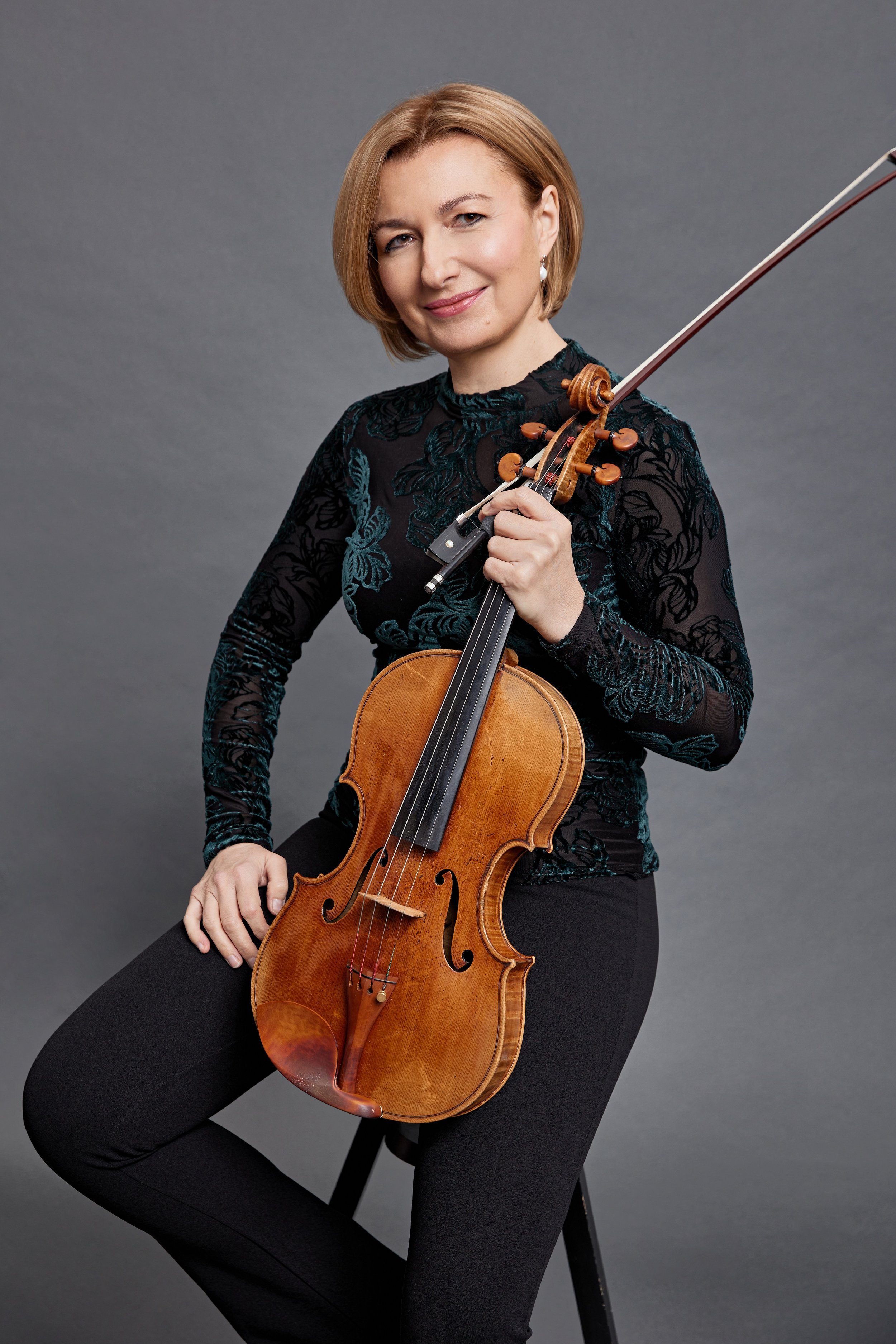
Rachel Roberts is one of Europe’s leading violists and performs internationally as a soloist and chamber musician.
As a soloist she has collaborated with conductors Christoph von Dohnanyi, Andras Schiff and Richard Hickox, performing concertos with the Philharmonia Orchestra, Koln Kammerorchester, Kammerphilharmonie Graubunden in Switzerland and the Manchester Camerata Chamber Orchestra amongst others. She was the featured viola soloist in the BBC TV documentary ‘The Passions of Vaughan Williams’ with Richard Hickox and the Philharmonia Orchestra, and has performed Mozart’s Sinfonia Concertante alongside violinists Christian Tetzlaff, Antje Weithaas and Benjamin Schmid in Germany, Switzerland and London. In January 2025 she recorded Edward Gregson’s Viola Concerto ‘Three Goddesses’ with the BBC Philharmonic, for future release on Chandos Records. Commissioned by the Presteigne Festival, the concerto was written especially for Rachel, and subsequently nominated for the 2024 Ivors Classical Awards (Best Large Ensemble Composition).
Rachel enjoys a busy schedule of chamber music. She has appeared as chamber musician at the Concertgebouw, Amsterdam, the Musikverein (Grand Saal) Vienna, Alte Oper Frankfurt, Wigmore Hall, Royal Festival Hall, Cadogan Hall, St John’s Smith Square and King’s Place in London. She is a regular guest at international chamber music festivals such as Salzburg Festival, Wiener Festwochen, Schubertiade in Schwarzenberg, Heimbach “Spannungen”, Mecklenburg Vorpommern, Hamburg “Oestertone”, Lofoten in Norway, and Stift in Holland.
Rachel is the violist of award-winning chamber music group Ensemble 360, with whom she gives frequent performances at Sheffield’s Crucible Playhouse as well as other venues across South Yorkshire. She regularly performs and records with Wigmore Soloists and Nash Ensemble, involving regular appearances at London’s Wigmore Hall, and has appeared with other celebrated ensembles such as the Tetzlaff String Quartet. Prizes for her chamber music recordings include thrice being awarded the coveted Diapason d’Or (2009, 2021, 2023), BBC Chamber Choice in BBC Music Magazine, and CD of the month in Fonoforum magazine, Germany. She has recorded chamber music for Hyperion, Champs Hill Records, Signum Classics, cAVI, Deutsche Rundfunk, Orchid Classics and BIS Records.
Following the success of her second solo CD (Schubert, Britten and Shostakovich) with pianist Lars Vogt on the cAVI label, Rachel Roberts has frequently joined Lars Vogt, Christian Tetzlaff, Antje Weithaas and Isabelle Faust for further chamber music collaborations, both in Germany and the UK.
Building on their highly successful collaboration at Wigmore Hall, in 2021 Rachel joined Christian Tetzlaff, Florian Donderer, Marie Elisabeth Hecker and Tanja Tetzlaff in Germany, to record and perform Schubert’s String Quintet in C major, D. 956. The resulting disc was released on the Alpha Classics label to critical acclaim.
Rachel is also a member of Trio Meister Raro alongside pianist Tim Horton and clarinettist Robert Plane, performing a selection of acknowledged masterpieces and fascinating curiosities, with a particular focus on themes of storytelling and fantasy.
Rachel Roberts is Professor of Viola at Guildhall School of Music and Drama and is a fellow of the Higher Education Academy. She has given masterclasses in the UK, Europe and Scandinavia. She holds the Institute of Education qualification: Professional Certificate in Teaching and Learning in Higher and Professional Education and many of her students are now enjoying professional careers in the UK and abroad.
Rachel Q&A
Venues: intimate venues versus huge concert hall
I don’t really experience intimate venues and big concert halls as opposites so much as distinct kinds of social and acoustic spaces. They both have their own special atmosphere and are capable of providing distinct experiences for performers and audiences. In a small space you might be able to hear and watch the breathing of a wind player up close, or viscerally experience the meaning of a bow change in a proximity that feels like you’re included in the music-making. In a large hall you might get more of a sense of the resonance and the scale of a work. Even after many years of playing in orchestras I still feel they can be magical gatherings of individuals galvanising to create one homogenous musical offering.
However, live music is sometimes described as a luxury in intimate venues such as schools and in communities, many of which aren’t offered the possibility of live performance. So if I had to choose I would advocate for intimate venues because of the dwindling appreciation of classical music in our country and because I feel that we have a responsibility as professional musicians to bring our work to people, rather than expect people to come to us. I passionately believe that live music and culture can help us to make sense of ourselves and one another by strengthening empathy and deepening reflection- so I think we need to create opportunities for communities to gather aroundsomething larger than their individual concerns. Music cannot solve social problems on its own, but it can help create the conditions where people listen and connect to each other, and everyone deserves access to beauty, creativity and moments of shared reflection, don’t they? I think that beneath our backgrounds, professions and life experiences we all share the longing to belong, to be understood, and to find meaning together in through the stories we share – in music or in any kind of art – whether that’s in a church hall or the Albert Hall.
Inspirational teachers, people or recordings /what got you into music?
I thought I would give a short list of inspirational quotes, either fromconversations I’ve had, overheard, or teaching sentences that I’ve taken in deeply.
A)“Be hot on the inside and cool on the outside” This is Roger Raphael, one of my earliest teachers, referring to the necessity for inner, unswerving connection to the music with total conviction and commitment, whilst allowing a sense of release and fluency in the muscles to be able to get around the instrument.
B) Mikhail Pletnev (conducting) to Janine Jensen (playing Sibelius Violin Concerto
2nd movement:M.P: “Are you sure you want to choose such a slow tempo – it will be hard for you to sustain your bow at this point.”
J.J: “That might be true, but all I can do is try.”
I loved her for this – he was doing his best to undermine but she remained strong, replying with humility and a commitment to the music as she imagined it. I found this inspirational and I never forgot it.
C) “Everyone cooks with water” – Lars Vogt, pianist. He was referring to the fact that everyone has to start somewhere – and every person may have their own unique ‘ingredients’ to add to their musical recipe for a performance, but that we’re all human, we’re all made of basically the same stuff, everyone has strengths and weaknesses, and we’re all just doing our best.
3. Favourite non-classical track?
“World Shut Your Mouth” by Julian Cope in 1987.
This track is fun, gives me a sense of liberation and encourages me to trust my own instincts. Independence is important musically, along with a refusal to be confined by others' expectations.
4. Famous person you'd most like to collaborate with?
Queen Elizabeth 1st. What an inspirational woman and all-round force of nature – strategically brilliant, extraordinarily resilient and unwaveringly committed to her cause.